Identity Resolution Overview
Identity Resolution sits at the core of Segment. The Identity Graph merges the complete history of each customer into a single profile, no matter where they interact with your business. Identity Resolution allows you to understand a user's interaction across web, mobile, server, and third-party partner touch-points in real time, using an online and offline ID graph with support for cookie IDs, device IDs, emails, and custom external IDs. If you are sending the Group call, you can also understand user behavior at the account-level.
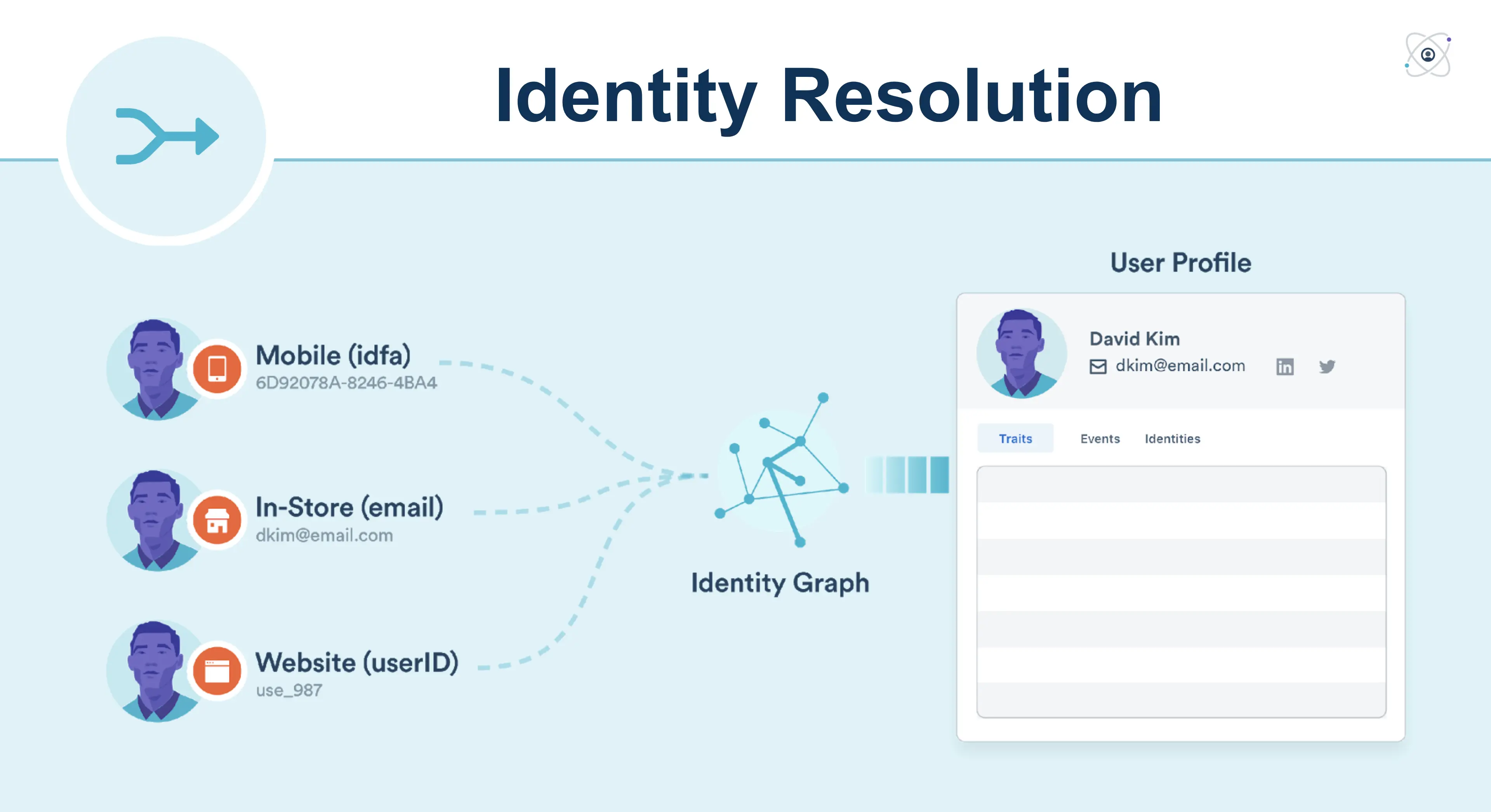
- Supports existing data — no additional code or set up required.
- Supports all channels — stitches web + mobile + server + third party interactions into the same user.
- Supports anonymous identity stitching — by merging child sessions into parent sessions.
- Supports user:account relationships - for B2B companies, generates a graph of relationships between users and accounts.
- Real-time performance - reliable real-time data stream merges with minimal latency.
- Supports custom external IDs - bring your own external IDs.
- Customizable ID Rules — allows you to enforce uniqueness on select external IDs and customize which external IDs and sources cause associations.
- Merge Protection - automatically detects and solves identity issues, like non-unique anonymous IDs and the library problem using the priority trust algorithm.
- Maintains persistent ID - multiple external IDs get matched to one persistent ID.
Segment's Identity Resolution treats all identifiers, including userId, anonymousId, and groupId, as case insensitive.
When Segment receives identifiers with different casing (for example, User_123 and user_123), it resolves them to the same profile. When an identifier is first received, Segment stores and uses that original casing as the canonical representation within the profile. Subsequent events with the same identifier in different casings match to the same identity.
Profile explorer display
While Segment merges case variants into one profile, the Profile explorer may display multiple casing variants as separate entries.
For security reasons, Segment requires that the Profile API only be used server-side. The Profile API allows you to look up data about any user given an identifier (for example, email, anonymousId, or userId) and an authorized access secret. While this enables powerful personalization workflows, it could also let your customers' data fall into the wrong hands if the access secret were exposed on the client.
Instead, by creating an authenticated personalization endpoint server-side backed by the Profile API, you can serve up personalized data to your users without the risk of their information falling into the wrong hands.