Identity Resolution
Identity Resolution is how Conversation Memory creates, matches, and merges customer profiles across channels.
When a customer contacts you through any channel — Voice, SMS, WhatsApp, or Email — Conversation Memory needs to determine who that customer is and whether a profile already exists for them. Identity Resolution is the process that makes this determination: it decides whether to create a new profile, add data to an existing one, or merge profiles where identifiers overlap.
Identity Resolution is built on four interconnected concepts that work together to identify and track your customers:
| Concept | Description | Example / Notes |
|---|---|---|
| Trait | Any factual attribute about a customer. | Name, address, subscription tier, language preference, zip code |
| Identifier | A trait promoted to uniquely identify a customer across interactions. | Email address, phone number, User ID |
| Identity Rule | Configuration that governs how an identifier is used for matching, storage, and normalization. | Phone: exact match, up to 100 values, FIFO eviction set by default |
| Profile | The unified container for all customer data resolved via identity, including traits, observations, and conversation history. | Jim's full record: name, phone, email, past interactions, preferences |
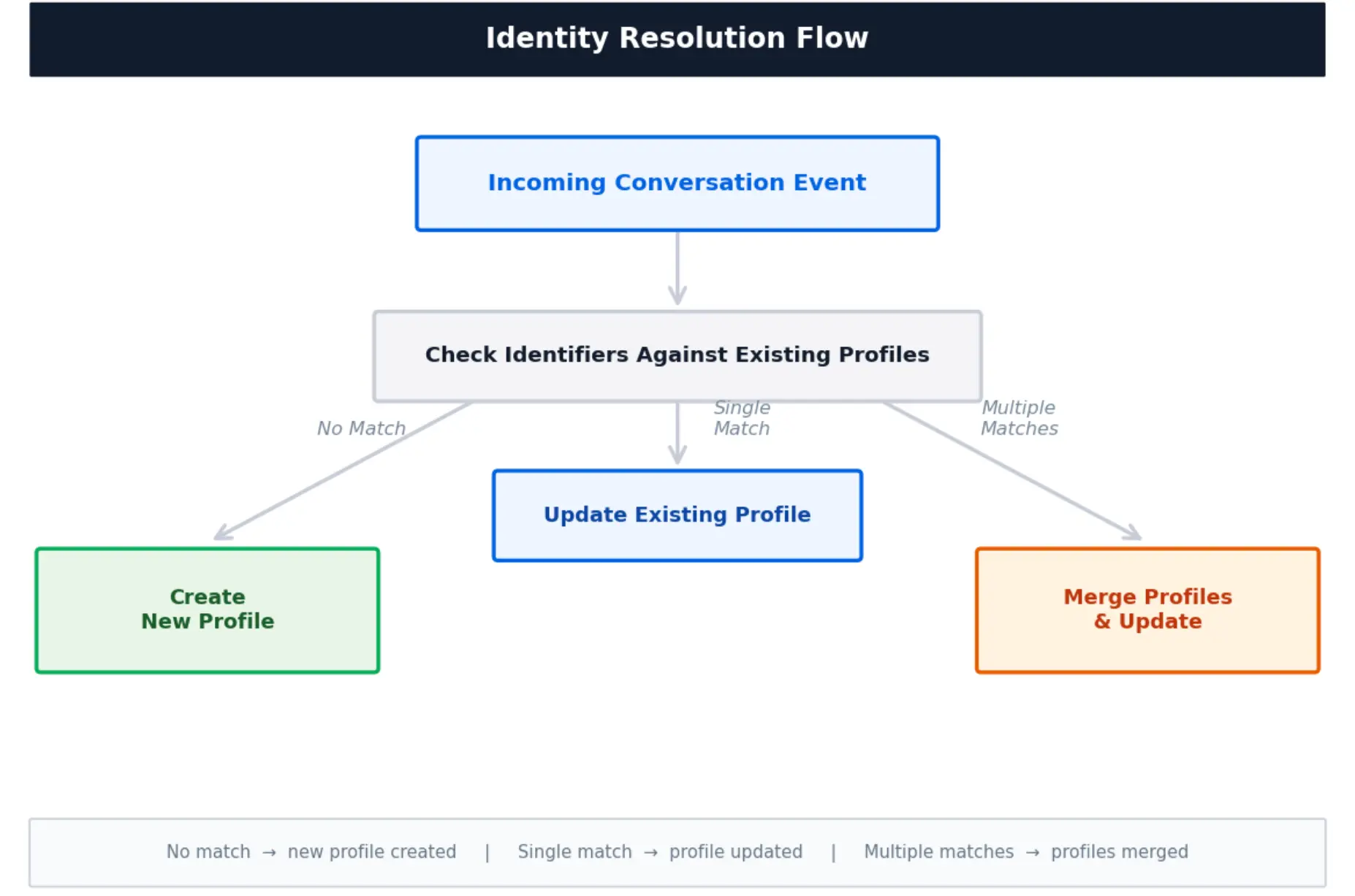
When a new conversation arrives, Conversation Memory extracts identifiers from the event and checks them against existing profiles in priority order. One of three outcomes results:
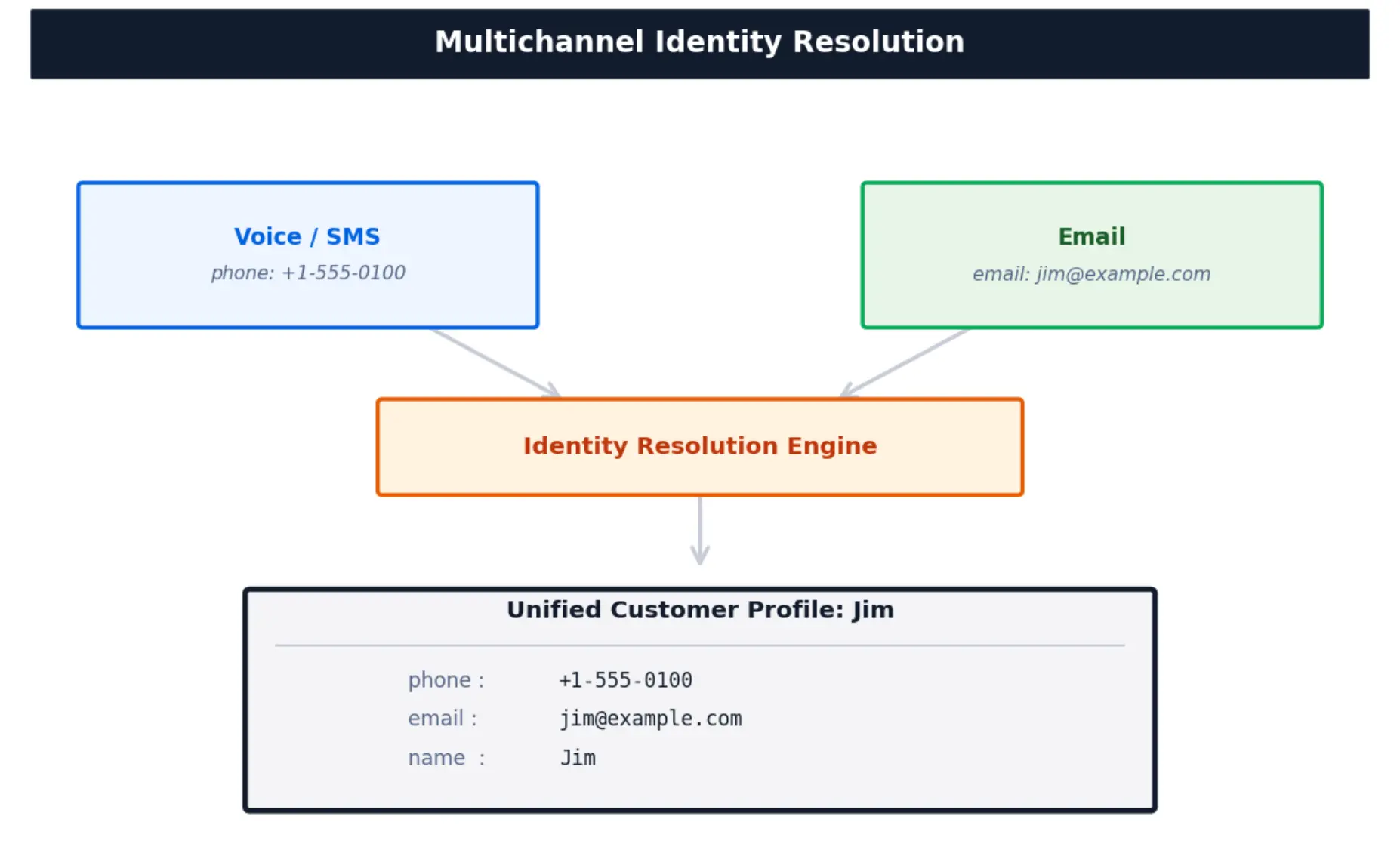
A customer can be recognized across different channels as long as an identifier is present and hydrated for each channel into the customer profile. In the example below, a phone identifier and an email identifier both belong to the same person — and Identity Resolution links both channel interactions to a single unified profile.
Every Conversation Memory store is provisioned with four default Identity Rules. These are reserved, automatically normalized, and mapped to incoming traffic from their respective Twilio channels:
| Identifier | Channel | Notes |
|---|---|---|
| Normalized to lowercase; case-insensitive matching | ||
| Automatically mapped from incoming Twilio WhatsApp traffic | ||
| phone | Voice, SMS, RCS, MMS | Automatically normalized to E.164 format before matching |
| chat | Chat | Normalized using trim; string passed by a consumer or app |
When an incoming event contains multiple identifiers, Identity Resolution evaluates them in priority order — the highest-priority identifier is checked first, and the first match wins. An example of a typical priority order is:
- user_id (Priority 1) — Most stable and unique; sourced directly from your own systems.
- email (Priority 2) — Reliably unique in most deployments; low risk of being shared.
- whatsapp (Priority 3) — Reliably unique in most deployments; low risk of being shared.
- phone (Priority 3) — Widely used but can change or be reassigned over time.
- chat (Priority 4) — Can change or be reassigned often.
Best practice: Proactive profile hydration
Conversation Memory works out of the box with Twilio Conversations and channels. However, the most consistent cross-channel experience comes from proactively uploading customer profiles before interactions begin — linking identifiers such as User ID, phone, email, and WhatsApp number together in a single profile.
Example: Jim contacts your support team via SMS. Conversation Memory creates a profile linked to his phone number. A week later, Jim emails your support address — but because no email identifier was pre-linked to his phone profile, Conversation Memory creates a second profile. Your agent sees no prior context and must start from scratch.
With proactive hydration, Jim's profile is uploaded in advance with his user_id, phone, and email all linked together. When Jim contacts you via any channel — SMS, email, WhatsApp, or Voice — Conversation Memory instantly resolves his identity to the same unified profile, ensuring agents have complete context.